MMR Checker
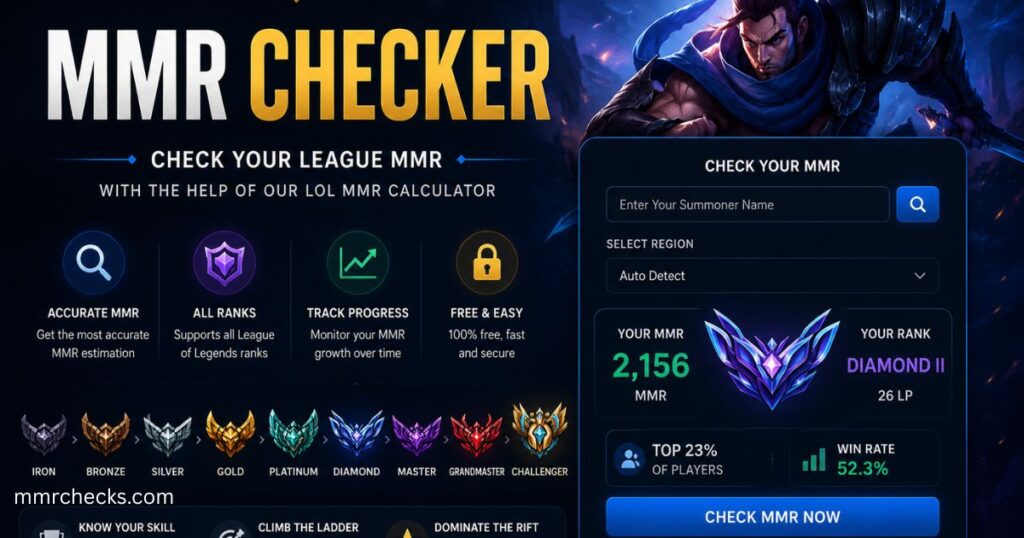
Check your League of Legends MMR with the help of our LoL MMR Calculator — instantly see your hidden rank, percentile, and LP predictions.
Select Region
How our MMR Checker works
Why You Should Check Your MMR Before Playing Another Ranked Game
There’s a moment every League of Legends player knows too well.
You just won three games in a row. You are playing well. Your mechanics feel sharp. But somehow, you are only gaining 14 LP per win and losing 22 LP every time you make one mistake.
It feels unfair. It feels broken. And most players just rage at the game without ever understanding why it’s happening.
Here’s the truth: your MMR is probably the reason.
And once you understand that, everything starts to make sense.
What Is MMR, Really?
MMR stands for Matchmaking Rating. Think of it as your real hidden rank ,the number Riot Games uses behind the scenes to match you with players of similar skill.
Your visible rank , Gold IV, Platinum II, or Diamond III, is just a display. It tells the world where you are on the ladder. But your MMR tells the game how good you actually are.
Here’s where it gets interesting.
These 2 numbers don’t always match.
A player can be sitting in Gold IV but have the MMR of a Platinum player. That means the game knows they belong higher, so it rewards them with more LP per win to push them up faster. On the flip side, someone can be in Platinum and have the MMR of a Gold player , and the game will quietly punish them with lower LP gains until the rank reflects reality.
The Problem Nobody Talks About
Most players spend hours analyzing their mechanics, watching pro replays, or blaming teammates. But they never stop to ask one simple question: does my MMR match my rank?
That one question can change how you approach every ranked session.
Let me give you a real example.
Imagine a player , let’s call him Zain. He’s from Delhi and plays on the EUW server because the ping is more stable than local servers. He climbed from Silver to Gold last season and felt proud. But this season, no matter how well he played, he was stuck. Winning games but barely gaining LP.
He didn’t have a coach. He didn’t have a team. He just had the game and his own instincts.
When he finally checked his MMR using a tool like the one at mmrchecks.com, he realized his MMR had fallen significantly below his current rank during his loss streak two months ago. The game wasn’t rewarding him because it didn’t believe he belonged in Gold anymore , even though his visible rank still showed it.
That single discovery changed how he played. Instead of grinding 10 games a day hoping for luck, he focused on consistent performance to rebuild his MMR first. Within three weeks, his LP gains jumped from 14 to 21 per win.
Same player. Same server. Different awareness.
Why Checking Your MMR Actually Matters
Let’s break this down practically because this is where most guides go vague.
Your MMR affects three things directly.
First, it controls your LP gains and losses. High MMR relative to your rank means bigger LP gains and smaller LP losses. Low MMR means the opposite. You bleed LP slowly even when you’re winning.
Second, it decides who you play with and against. If your MMR is higher than your visible rank, you’ll often be matched with players from higher divisions. That’s why some Gold players constantly face Platinums. The game knows something your rank doesn’t.
Third, it affects how quickly you climb or decay. If your MMR is healthy, even a mediocre win rate can keep you climbing. If your MMR is low, even a decent win rate might feel like you’re standing still.
None of this is visible in the client. Riot doesn’t show you your MMR. That’s a deliberate design choice; they do not want players obsessing over a number. But the consequence is that millions of players grind ranked without understanding the invisible force shaping every game they play.
The Beginner Mistake That Costs Months of Progress
Here’s a mistake that’s incredibly common, and it’s not about mechanics at all.
Players go on a tilt loss streak. Maybe five, six, seven losses in a row. It happens to everyone. But instead of stopping, they keep queuing because they want to “win it back.” They play angry, distracted, and rushed.
What they don’t realize is that every loss during tilt is actively destroying their MMR. Not just their LP, but their hidden rating that controls everything.
By the time the loss streak ends, they might have recovered their LP through wins. But their MMR is damaged. And now their gains are lower, their losses are higher, and they can’t figure out why climbing feels so much harder than before.
In Pakistan, there’s a phrase people use, “ghante ki mehnaat, minute mein barbaad,” which roughly translates to hours of hard work destroyed in minutes. It applies perfectly here. A healthy MMR built over weeks can be damaged in a single bad afternoon of tilt queuing.
Checking your MMR regularly helps you catch this early. If you notice your estimated MMR dropping below your visible rank after a rough patch, that’s your signal to stop, reset, and come back with a clear head.
How an MMR Checker Actually Works
Tools like the MMR checker at mmrchecks.com work by pulling your recent match data and analyzing patterns that reflect your hidden rating.
They look at things like your LP gains and losses per game, the average rank of players you’re being matched against, your win rate over recent games, and how the game is weighting your results.
From this data, they estimate your current MMR and compare it to your visible rank. The result tells you whether you’re above, below, or in line with where your rank says you should be.
It’s not a perfect science , Riot doesn’t publish the exact formula. But the estimates are accurate enough to give you genuinely useful information. Think of it the way a weather forecast works. It’s not guaranteed, but it’s informed enough to help you make better decisions.
What to Do With Your MMR Results
This is the part most guides skip. They tell you how to check your MMR and then leave you there. So let’s go further.
If your MMR is higher than your rank, congratulations. The system is already working in your favor. Focus on maintaining consistency. Don’t go on tilt. Keep your win rate above 50 percent and you’ll climb faster than the average player at your rank because your LP gains are boosted.
If your MMR matches your rank, you’re in a neutral state. Climbing requires genuine improvement ,either winning more games or improving your performance quality to start pulling your MMR up above your rank again.
If your MMR is lower than your rank, this is the situation that needs the most attention. You’re in what players call an “MMR hole.” Your immediate priority isn’t climbing , it’s stabilizing. Play for consistent wins, not aggressive plays. Reduce your champion pool. Focus on role mastery. You need to close the gap between your MMR and your visible rank before sustainable climbing becomes possible.
A Tool That Gives You What the Game Wont
Riot built League of Legends to keep you playing without fully understanding the system. That’s not cynical , it’s just how the game is designed. The mystery keeps things interesting for casual players.
But if you’re serious about climbing, you can’t afford to play blind.
Using an MMR checker is about taking control of information that affects every ranked game you play. It takes two minutes. It costs nothing. And it gives you a clearer picture of where you actually stand than anything the client shows you.
Players in South Asia, Pakistan, India, and Bangladesh often grind League on limited time. Work, studies, power outages, and connection issues all cut into playtime. Every ranked session matters more when you have fewer hours to play. Knowing your MMR before you queue means you’re making those hours count instead of unknowingly digging yourself deeper into an MMR hole. That’s why you must visit mmrcheks.com
The Bottom Line
MMR is the real language League of Legends speaks. Your visible rank is just the translation.
If you’ve ever felt stuck despite winning, frustrated by low LP gains, or confused about why your climb feels harder than it should, checking your MMR is the first step to actually understanding what’s happening.
It won’t fix your mechanics. It won’t win games for you. But it will show you the truth about where you stand, and sometimes, that’s exactly what you need to start moving forward.
Check your MMR. Understand the gap. Then close it, one consistent game at a time.
Thank you for visiting mmrchecks.com.