

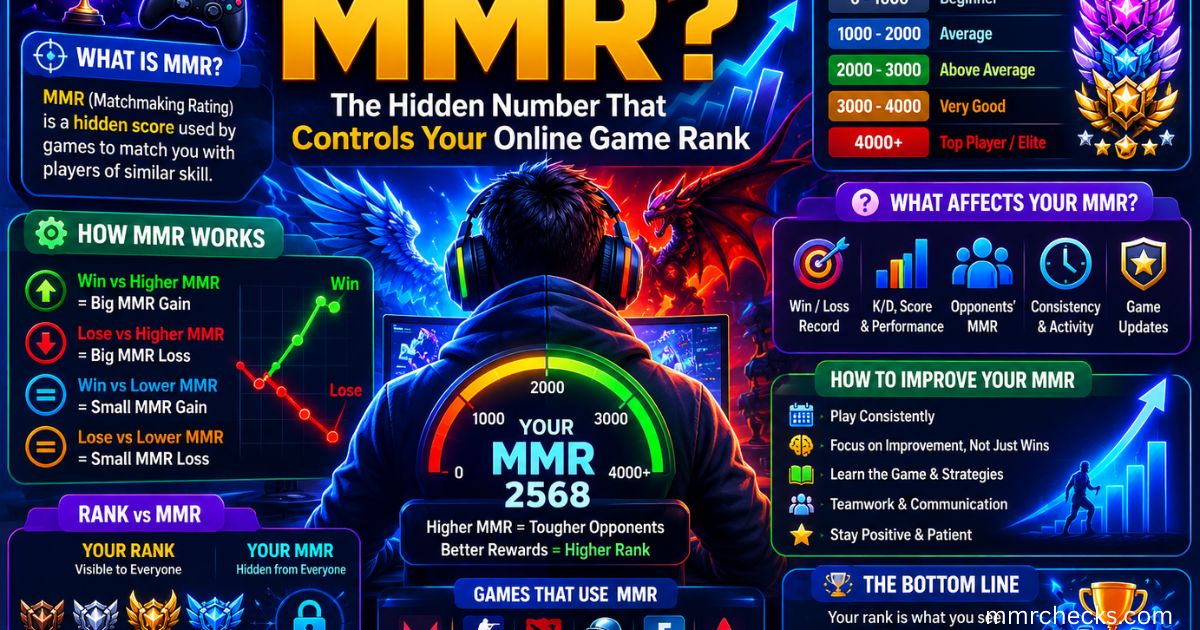
There is a number attached to your gaming account right now.
You can not see it. how MMR works in games Most games won’t show it to you directly. But it controls everything: who you get matched against, how fast you climb, and why some nights feel like you’re winning every game while other nights feel like the universe is personally out to get you.
That number is called MMR.
And once you understand it, the way you think about online gaming changes completely.
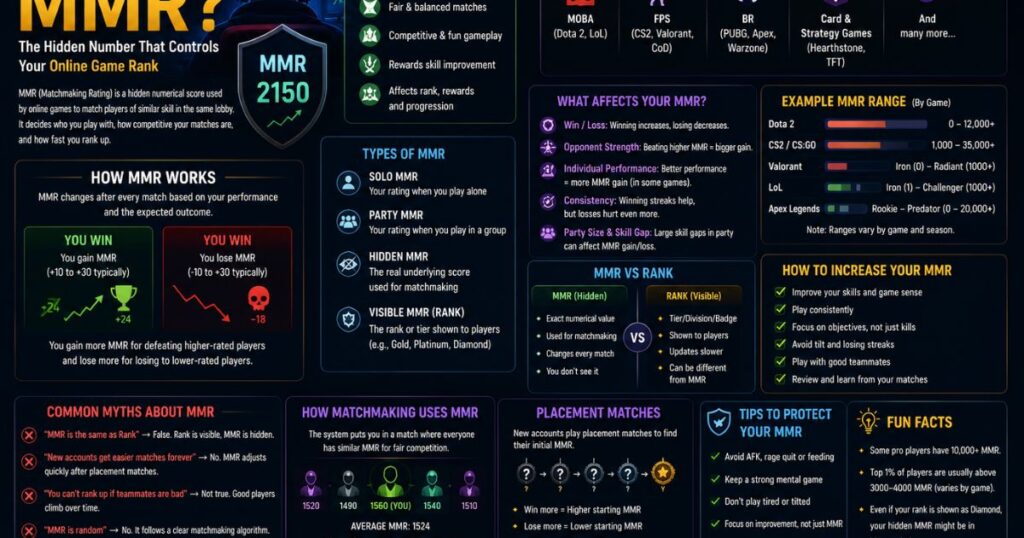
So What Exactly Is MMR?
MMR stands for Matchmaking Rating.
It is a numerical value that gaming systems use to measure your skill level. Every time you play a ranked or competitive match, your MMR goes up when you win and goes down when you lose. The system uses this number behind the scenes to find opponents who are roughly at your level. That ihttps://happysmurf.com/mmr-checker/s what mmrchecks.com wants to inform you.
Think of it like a school grading system. But instead of grading your homework, it is grading your performance in every single match you play. Keep in touch mmrchecks.com
The concept did not start with gaming. It actually comes from chess. A Hungarian-American physics professor named Arpad Elo created a mathematical rating system in the 1960s to rank chess players fairly. That system, known as the Elo system, became the foundation for almost every MMR system used in online games today.
So when you are grinding ranked matches in League of Legends, Dota 2, Valorant, or any other competitive game, you are essentially playing inside a system invented for chess. Interesting, right?
Why Games Hide Your MMR,
Here’s something that frustrates a lot of players.
Most games don’t show you your actual MMR number. Instead, they show you a rank. Something like Gold, Platinum, Diamond, or Challenger. Or they show you a visible rating number that moves slower than your actual MMR.
Why do they do this?
Because the real MMR number moves constantly and can feel chaotic. If you could see it jump up and down after every single game, it would feel stressful and discouraging. The visible rank is a smoother, more stable representation designed to feel rewarding as you climb.
But the hidden MMR is always running in the background, quietly making the real decisions.
Some players in Pakistan, India, and other South Asian countries spend hours on forums trying to find tools or websites that reveal their hidden MMR. In games like Dota 2, third-party sites like OpenDota or Dotabuff can actually show you estimated MMR data. In other games like Valorant, your MMR is much more tightly locked away.
How MMR Actually Works: A Simple Example,
Imagine 2 players. Call them Haron and Jake.
Haron has been playing for three months. He wins about 56% of his games. His MMR is 2,400.
Jake has been playing for 2 years. He wins about 49% of his games. His MMR is 2,350.
The matchmaking system looks at these two numbers and decides these players are close enough in skill to share a match.
Now Haron wins. His MMR goes up, something like 2,425. Jake loses. His MMR drops, landing around 2,320.
But here’s the important part. The amount your MMR changes after each match isn’t fixed. It depends on the gap between the 2 players’ ratings.
If Haron , who has the higher rating, beats Jake, he gains fewer points because that was the expected outcome. But if Jake, who has the lower rating, beats Haron, Jake gains a lot of points and Haron loses a lot. The system rewards upsets and punishes unexpected losses.
This is the Elo logic working in real time.
MMR vs. Visible Rank,What’s the Difference?
A lot of new players confuse these two things. They’re related but not the same.
Your visible rank, like Silver 3 or Platinum 2, is what your profile shows publicly. It’s the badge. The trophy. The thing you screenshot and send to your friends.
Your MMR is the engine underneath. It’s the actual skill measurement.
Here is where it gets interesting. You can have a Gold rank but a Platinum MMR. This happens when you have been winning consistently but your visible rank has not fully caught up yet. In this case, the game gives you more rank points per win and deducts less per defeat. It’s trying to push your visible rank up to match where your MMR already sits.
The opposite can also happen. You could be showing Diamond rank but carrying a Platinum MMR. Usually because you had a lucky streak or played during a rank reset and your visible rank got inflated. In this case, losses hit harder and wins reward less. The game is slowly pulling your rank back down to where your MMR says you actually belong.
Players call this being hard stuck. And now you know the actual mathematical reason why it happens.
Seasonal Resets and Why Your MMR Doesn’t Fully Reset
Most competitive games have seasonal rank resets. A new season starts, your rank gets wiped or lowered, and you do placement matches to find your new starting point.
But here’s what many players do not realize.
Your MMR does not fully reset. The game remembers your skill from before. So when you do your placements, the system already has a rough idea of where you belong and places you close to your previous level, maybe slightly lower to give you room to climb again.
This is why a Diamond player from last season typically gets placed back somewhere in Platinum or low Diamond after resets. Not in Bronze with complete beginners. The hidden MMR carries your history forward.
For players in Pakistan or South Asia who switch accounts or buy smurf accounts hoping for an easier climb, this logic also explains why new accounts sometimes get placed surprisingly high after strong placements. The system picks up on skill signals quickly. Keep in touch with mmrchecks.com for more info.
What Affects Your MMR the Most?
Wins and losses are the obvious ones. But there’s more to it depending on the game.
In team-based games like League of Legends or Valorant, your individual performance does have some influence. But the primary driver is whether your team wins or loses. You can play the best game of your life and still lose MMR if your team loses.
In games like Dota 2, your individual stats, things like kills, assists, deaths, and damage, can influence how much MMR you gain or lose even within the same result.
In chess-style games and pure 1v1 formats, it’s cleaner. You win, you go up. You lose, you go down. No teammates to blame.
The one thing consistent across all systems is this. Consistency beats everything. A player who wins 55% of their games across 500 matches will always end up higher than a player who wins 70% across 50 matches. Volume and consistency are what the system rewards over time.
Common MMR Mistakes Beginners Make
The biggest mistake is playing too many games in a bad mental state.
When you’re tilted, frustrated, angry, or just tired, your decisions get worse. You play faster and more recklessly. Your win rate drops. Your MMR drops. And because you’re chasing losses, you keep playing. Five more losses. Ten. You wake up the next morning having fallen two rank divisions in one night.
This is sometimes called an MMR spiral. It’s real, and it happens to players at every level. From beginners in Karachi to professional players in Seoul.
The fix is simple but hard to actually do. Stop after two consecutive losses. Come back tomorrow. One disciplined session of three wins does more for your MMR than seven frustrated games where you go 2 and 5.
Another mistake is ignoring role impact. In team games, certain positions have more influence on the game outcome than others. Learning which roles carry the most weight in your specific game and focusing there can accelerate your MMR climb significantly.
Does MMR Matter Outside of Ranked Mode?
Yes, more than most players think about,
Even in casual or unranked modes, most games still track a hidden MMR. It’s just used differently. Instead of affecting your rank, it’s used purely for matchmaking, to make sure your casual games are still somewhat balanced and enjoyable.
Some games also use separate MMR values for different game modes. Your ranked MMR in Dota 2 is separate from your battle cup MMR, for example. Getting good at one mode doesn’t automatically transfer to another.
And in games with tournaments or community competitions, which are growing fast in Pakistan, India, and Southeast Asia, your MMR is often used as a qualification filter. Want to enter a tournament? You might need a minimum MMR just to register.
A Quick Note on MMR Boosting
MMR boosting is when someone pays a higher-skilled player to play on their account and raise their rank.
It’s against the terms of service in virtually every major game. It can result in a permanent ban. And beyond the rules, it creates a real problem. You end up in lobbies where players are better than you, you perform badly, and you either tank back down or have a miserable time trying to keep up.
It’s a shortcut that doesn not work. The MMR always finds its natural level eventually.
The Simple Truth About MMR
MMR is not your enemy. It’s just a mirror.
It reflects your current skill level based on your results. If you don’t like what it’s showing, you don’t break the mirror. You work on what’s being reflected.
The players who improve fastest are the ones who stop blaming teammates, stop obsessing over rank badges, and focus on one simple question after every loss. What could I have done better?
Try these for best,,
Find out what your real MMR actually is
The number follows the skill. Always
Thanks for visiting