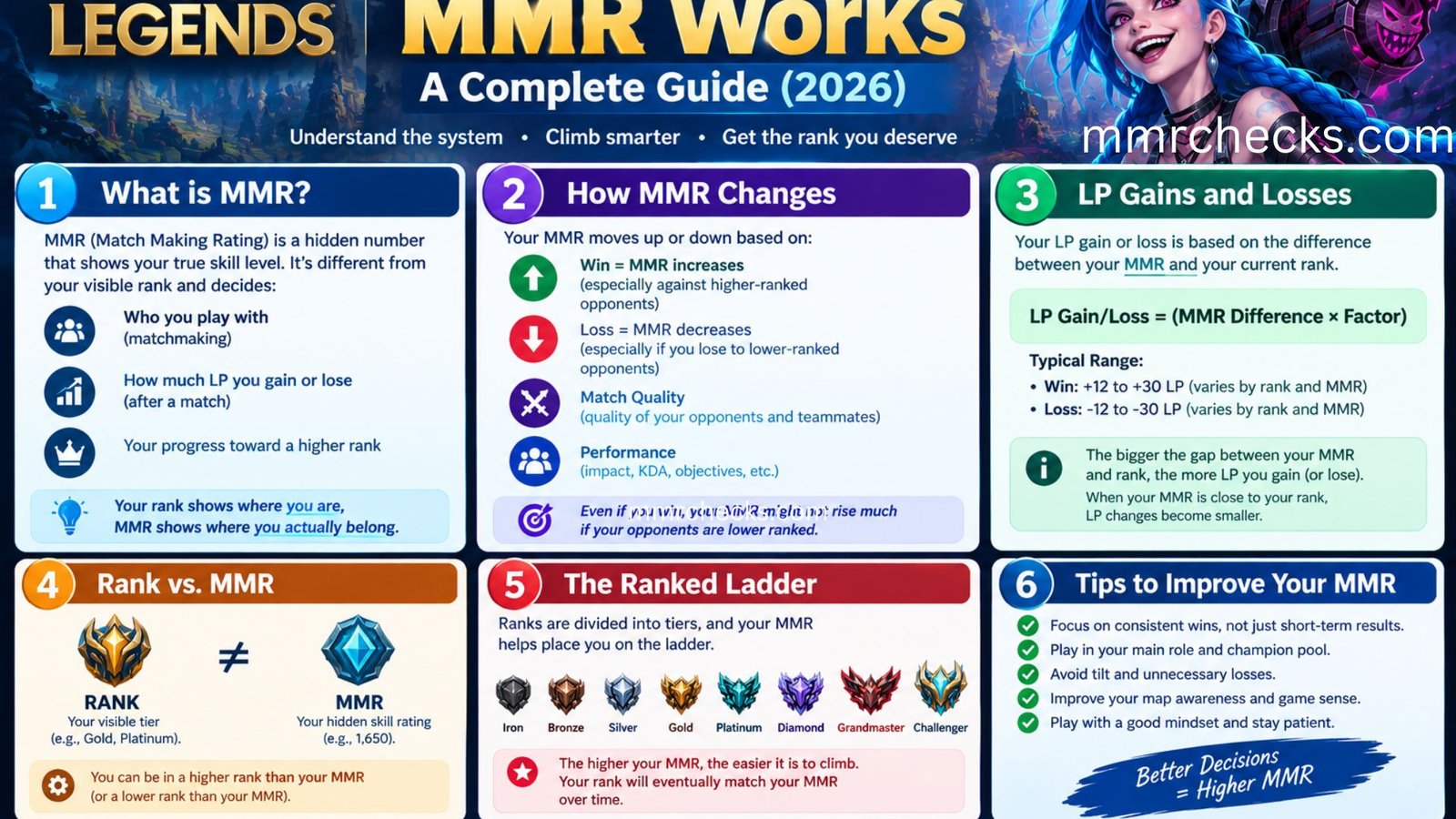
How League of Legends MMR Works
Navigating the League of Legends ranked ladder often feels confusing when your visible rank does not match your match outcomes. At the center of Riot Games’ matchmaking algorithm is the hidden Matchmaking Rating (MMR). Understanding how this hidden score operates is crucial for any player looking to climb efficiently.making it essential for competitive players to understand how League of Legends MMR works behind the scenes.”
What Is Hidden MMR in League of Legends?
Unlike your displayed rank, such as Silver I, Gold II, or Emerald IV, your Matchmaking Rating (MMR) is an undisclosed numerical value assigned to your account. This internal rating represents your true skill level as evaluated by the server.
Riot’s system uses your MMR for two primary functions:
- Lobby Creation: Matching you with and against nine other players of similar skill intensity.
- LP Adjustments: Determining how many League Points (LP) you earn for a victory or lose during a defeat.
The Relationship Between MMR and LP Gains: How League of Legends MMR Works
Your LP trajectory is direct feedback regarding where the system thinks you belong on the ladder:
- MMR Higher Than Visible Rank: The algorithm attempts to fast-track your progression. You will experience large LP gains (+22 to +28 LP) on wins and small LP losses (-10 to -14 LP) on losses.
- MMR Matches Visible Rank: Progression stabilizes. You will notice balanced gains and losses around +18 to +20 LP / -18 to -20 LP.
- MMR Lower Than Visible Rank: The system believes your visible badge is inflated. You will face heavy LP penalties (-22 to -26 LP) on losses while receiving reduced rewards (+12 to +15 LP) on wins.
Key Factors Influencing Rating Velocity
- Win/Loss Margins: Consistently winning games against lobbies with higher average team MMR accelerates rating gains faster than defeating lower-ranked opponents.
- Demotion Shield Penalties: Repeatedly losing matches while sitting at 0 LP severely lowers your hidden rating baseline without immediately dropping your visible tier badge.
- Duo Queue Variances: Playing with partners of vastly different ranks adjusts the overall lobby average, impacting individual rating recalculations over time.
How to Fix a Damaged MMR Account
If your account suffers from negative LP gains, the only fix is consistent victory over a sustained stretch. Maintaining a 55%+ win rate across 15 to 20 consecutive ranked games recalibrates your hidden rating to match your visible rank.
Matchmaking Rating (MMR) is the core engine behind League of Legends competitive ranked play. While your visible rank tier.ranging from Iron to Challenger.serves as a cosmetic milestone for your achievements, your hidden MMR is the actual metric Riot Games uses to balance lobbies and calculate post-match League Points (LP).
What Is Hidden MMR in League of Legends?
Hidden Matchmaking Rating is a numerical score assigned to every account that measures individual skill relative to the entire player base. Unlike your visible badge, this score remains undisclosed to prevent manipulation of the competitive ladder.
The primary objective of the matchmaking algorithm is to create balanced lobbies where both teams have a near 50% probability of victory. When you enter a queue, the server averages the hidden scores of all ten players to assemble a fair competitive environment.
How Hidden MMR Dictates Your LP Gains and Losses
Your visible rank constantly attempts to catch up with your hidden score. The relationship between these two systems dictates your point trajectory after every victory or defeat:
- High Hidden Rating (Accelerated Climbing): If your skill rating is significantly higher than your current visible badge (e.g., your MMR matches Gold II but your badge shows Silver I), the system accelerates your progression by awarding elevated LP (+22 to +28 LP) on victories while minimizing losses.
- Balanced Rating (Standard Velocity): When your hidden rating aligns naturally with your visible division, point adjustments remain steady, typically yielding around +18 to +20 LP for a win and -18 to -20 LP for a loss.
- Depressed Rating (Negative LP Ratio): If a long losing streak causes your hidden rating to drop below your visible tier, the algorithm attempts to drag your badge down by granting smaller gains (+12 to +14 LP) and harsher penalties (-22 to -25 LP).
Key Factors That Influence Your Account Rating
When analyzing how League of Legends MMR works, several matchmaking variables directly impact your rating gains
- Match Outcome & Opponents’ Skill: Victory against a lobby with a higher average rating increases your hidden score more significantly than beating a lower-rated team.
- Demotion Shield Losses: Losing games while sitting at 0 LP in a division threshold prevents your visible badge from dropping immediately, but it severely depresses your underlying skill score.
- Duo Queue Disparities: Frequently queueing with partners whose ratings differ from yours introduces variance into how the algorithm evaluates individual match contributions.
Effective Strategies to Improve Your Rating Baseline
- Maintain Consistency Across 20+ Games: Rebuilding a damaged rating requires sustaining a 55%+ win rate across a moderate sample size of matches rather than expecting instant fixes.
- Dodge Unfavorable Champion Selects: Dodging a high-risk lobby costs visible LP and triggers a queue timer, but it preserves your hidden rating baseline completely.
- Focus on Solo Queue Progression: Playing solo ensures that lobby averages reflect your personal skill curve without duo inflation or rating variance.
- Mastering the mechanics of how League of Legends MMR works allows players to climb the ladder more efficiently.
Frequently Asked Questions About LoL MMR
Q: Can I check my exact numerical MMR score inside the Riot Client?
No, Riot Games does not expose exact MMR numbers within the client. However, you can estimate your rating trajectory by evaluating your average LP gains per match.
Q: Does playing Normal or ARAM matches affect my Ranked MMR?
No, Riot Games maintains separate queues with independent rating baselines. Your performance in Normal, ARAM, or rotating game modes has no direct impact on your Ranked queue rating.
Q: How long does it take for LP gains to normalize after a loss streak?
Restoring balanced LP gains usually requires 15 to 25 games with a positive win ratio (above 55%), allowing the algorithm to verify that your actual skill matches your visible division.
To calculate your account baseline and estimate your ladder progression, use our live League of Legends MMR Checker and evaluate your points trajectory with our LP Calculator.
Now that you understand how League of Legends MMR works, you can evaluate your ladder velocity with greater precision